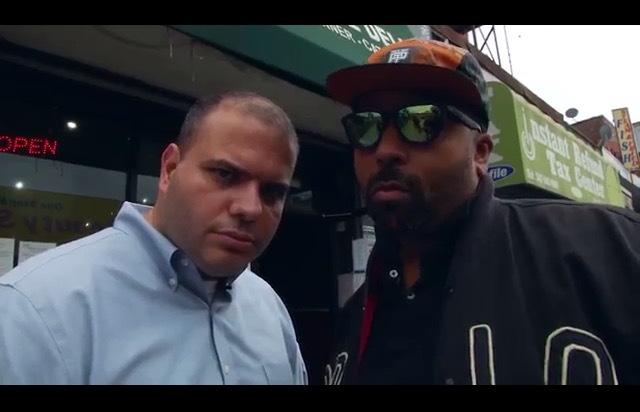
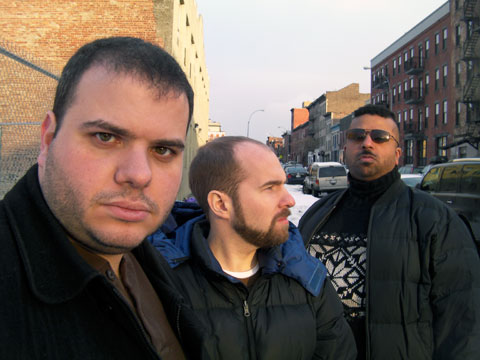
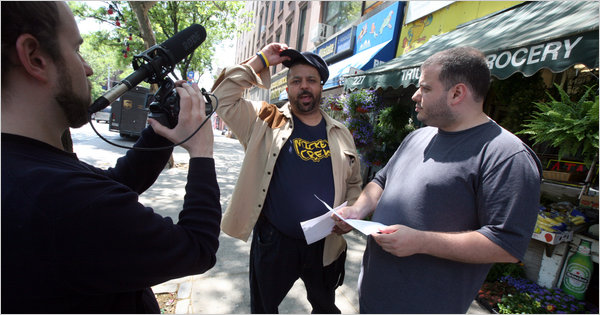
When you hear a song as funny as “Always” by the Hazzards, you know it needs a video.
True story, I was not super amped to begin with on this project - if only because I was so used to the more lo-fi, documentary productions I’d been doing here with the ICs. I’m not saying it’s easier but working on a set demands more precision and timely execution than shooting the hell out of documentary shooting ratio. I could not have done it without a lot of excellent people: Matt Elkind, Kayla Graffam, Oliver Butler, Sigal Inbar, Sydney Maresca, Anne Harris, Simon Astor, Hannah Bos - to name just a very few.
But I think it came out great. And I’m really glad I directed it.
Since I make most of my money by writing and producing commercials, I thought it’d be fun to apply a cable channel’s logic to the Internets Celebrities video flow.
We’re about to drop our biggest documentary yet and in service of that, I thought I’d tease the premiere.
The good/bad thing about promos (on TV or otherwise) is that the science of ratings is inexact. Trailer-makers and promo-producers can never take the full credit or full blame for the size of an audience (or lack thereof). It’s basically viewed as a can’t hurt type of format. Promos get a lot of scrutiny (sometimes too much) because they’re often the first chance that the audience has to look at the actual show.
I just want promos or commercials I make to leave the viewer with the same feeling I get from watching a good trailer in the theater: Damn, I’d like to see that movie.
Failing that, I’d settle for a WTF.
In any event, the above promos are two jokes that I liked a lot from the footage we shot for our new doc that didn’t fit in the final cut. Or maybe they’re in the final cut. Or maybe I’ve said too much.
My mom asks: “How many movies do you have on youtube now?”
“48”
“Oh.” She chooses her words carefully. “ I hope you don’t wake up at 40 with just 100 movies to show for it.”
Clearly, to her, short films still retain the traditional stigma of unimportant filmmaking. 100 short films would just be 100 pieces of a compromised totality.
I contend that this is an exciting time for short films with lots of places that want them and the average attention span of the average viewer getting shorter and shorter. More can be said in a smaller period of time - blah blah blah.
That was the kneejerk response I had to my mom’s statement – wherein I defended short films as a viable form and posed the comparison of 100 good shorts against 2-3 mediocre to crappy features. But her purpose wasn’t to denigrate shorts. I think she was just making sure that what I was doing was what I wanted to be doing – that it wasn’t just habitual.
Would 100 or whatever the amount of short videos I’m on pace to make by 40 be a satisfying goal for me?
Even though it’s kind of a misleading point-of-view, I sometimes look at my output with a legacy mindframe. Would I be happy having made this? Would I be happy having made that? Despite it being natural, this impulse feels misleading because it implies a life lived intending to serve one (hopefully) very distant moment of reflection. But it is a type of narcissism that puts your work into perspective. It makes you render the short view you take for granted with the long view superimposed over it.
I’ve wanted to make movies since I was 14. And I thought for a while that how to do this would become obvious if I was flexible enough. It took me a while to acknowledge that beyond developing a spectrum of necessary skills and experience, filmmaking involves answering a lot of hard questions. I think that’s true for any major life choice. You have to basically seal off paths so that you don’t get sidetracked or even worse, lost. You answer questions about what you want to do to make sure it’s specifically what you want to do or in service of that mission.
I bring this all up because I’ve been fascinated lately with all the possible permutations of goals available to the ambitious filmmaker or filmmaking group out there. With the internets going nuts and more and more places hungry for content, there are a huge amount of micro-goals. There are more ways than ever to make money, achieve artistic satisfaction and compromise one’s films and/or identity as a filmmaker. The ICs lately have had some emails back and forth about what our goals are and despite all seemingly being after the same prize (success in all its vague possibility), I wouldn’t say that we were able to answer all of the questions in front of us. Nor did I get the impression that we’d even asked all of the possible questions.
Our origin – as Dallas touched on a few posts back – was fairly serendipitous. Our first movie is still our most popular – in terms of number of views (or hateful comments – whichever you trust more as a metric) – and it was born of 2 hours of filming, 15 minutes after Rafi and I met Dallas for the first time.
Considering we barely prepared for that movie, there is a feeling of leaving things up to chance, of not taking the time to prepare and letting the chips fall where they may in future movies. Why ask questions? Just keep getting together with a camera and a concept and let ‘er rip.
But choosing happenstance as a key function of our aesthetic would be like basically choosing the laziest goal we could. Why not try and refine the strategy and get on the same page in terms of intention? Once your intentions are in sync, you become a much more efficient filmmaking squad. Ideas that don’t mesh with that intention can be thrown out with little dialogue and your energy can be focused on a more narrow field.
So here are some of the questions we were considering:
Should we only make movies about one topic? (i.e. food, social justice, etc.)
Should we try to make money?
Should we try to make A LOT of money?
Should we let money just kind of happen?
Should we make lots of movies?
Should there be a schedule to our output?
A new movie every month? Every week? Every year?
Should every movie be above a certain standard of goodness?
Or should we let a couple of lesser movies squeak through because they cover a timely topic?
Should timeliness trump quality?
If we do decide to make money, how should we do it?
Should we go after sponsorship?
Should we charge people to see our movies?
Should we try to make a DVD and sell it?
Should we try to get signed to a website or channel with budgets for filmmakers?
Should we just make the movies that we want to make having faith that good ideas will breed funding?
Should we make movies for the Internet only?
Should we consider how something is going to look at a film festival?
Are we trying to get picked up as a TV show?
Fuck TV!
The obsessive part of my personality likes the idea of creating this kind of questionnaire. Were we to establish that we only wanted to make monthly, lucrative movies about food above a certain level of goodness which we didn’t charge people for in the hopes of landing a sponsorship and playing on TV, we could close off the other circuits and narrow our focus.
The downside (besides eliminating some of the spontaneous discovery that I think filmmakers like myself tend to appreciate) is that we would have to live with those choices.
Goals are a hard thing to consider because they’re not like the goals you have when you’re a kid. When I was 14, my goal was to be a filmmaker. Now, my goals in terms of movie-making seem to be (in this order):
Making LOTS of moves capable of being seen on multiple platforms.
Making short videos that play almost exclusively on youtube where hopefully they get seen by lots of people.
Making short documentaries about food, holding New York City accountable for its discrepancies and rap shows.
Making music videos for my friends’ bands.
Making short comedies.
Writing/Conceptualizing a good feature that my friends and I can make
Narrative or Documentary
Writing a good feature that someone else can make which hopefully pays well
Making commercials which are artistically satisfying and pay well
Letting money just kind of happen
Getting shorts into film festivals
Ask me on a different day and the goals change order, develop new tangents and inspire doubt. But I think breaking your mission into categories, parts and interchangeable pieces ensures you’re thinking about your work and makes it more doable. You keep moving the parts around and ultimately, you develop your life.
So to return to my mom’s query: Would I be happy having made 100 shorts by the time I’m 40?
The answer is no.
But I might be happy having made 200 shorts, 1 excellent feature (narrative or documentary), 1 well-written but ultimately unsuccessful feature, 50 artistically satisfying and lucrative commercials while seeing a couple of those shorts play Sundance, Tribeca and Clermont-Ferrand – and being funded by a wealthy patroness of the arts.
I like to think Urine Nation succeeds as a guide for the bathroom challenged. But let’s face it - we’re a little low on actual facts and numbers. It’s all well and good to say find a hotel, find a Starbucks, find a phonebooth. But if I’m on corner A in neighborhood B, where the fuck is that actual fine hotel with the fancy handsoaps? We speak in generalities because it’d be more like a feature film, a decalogue even, to cinematically render ALL the locations deserving and accepting of your piss in Manhattan.
We keep it short video style because there are people out there like Tommy Mintz - an old high school chum of Rafi and I - who will go that extra mile. Ladies and Gentlemen, witness…
After the iNternets Celebrities returned from the Sundance Film Festival we were inspired to cover other events with our lens and our perspective. The first major summer event of 2007 was the Brooklyn Hip-Hop Festival. In a newly gentrified neighborhood underlooking the Brooklyn Bridge we gathered to watch a few artists from borough of Kings and some artists from other places spit their hot shit.
Unlike the film series that was created by our weeklong experience in the Utah mountains, the film set for the Brooklyn Hip-Hop Festival is the product of a single day of shooting. I give a lot of credit to Terrence Elenteny for finding the material in several hours of tape to create these films…
But I also need to shout out Cas and Rafi for being hardbody filmmakers who braved the oppressive 175 degree heat sunshine to remain at the festival until the very last minute.
My favorite video in the series was titled ‘The Lost Tapes’. Terrence and Cas describe the serious aspect of Hip-Hop in this video as they show the business people as well as the artists that encompass rap music. Inside of this video is a line from Rafi that has fully described my feelings for appreciating rap music - discerning. The other truly classic moment in this video is Rafi’s interchange with QB emcee Killer Shah.
What I always find to be sort of remarkable is the fact that I only see Rafi and Cas on days that we film, yet we never have too much of a problem finding our rhythm and speed after we give each other pounds [ll]. I’m still not sure what the future holds for the i.C. movement, but I will always enjoy watching the exploits of discerning Hip-Hop fans.
In this effed the eff up economy, it is important to capitalize on those special events where the organizers are promising free local wine, free cheese and free delicatessen snacks.
As it turns out those are my favorite kinds of wine, cheese and delicatessen snacks.
They’re playing all kinds of movies including our very own public pee opus, Urine Nation!
If you couldn’t tell what was going on in the phone booth on the small screen, you can savor every detail on the bigscreen this coming Monday. Here are the details:
What: Free short films in Chelsea Market with a live performance by Drew and the Medicinal Pen.
Where: Chelsea Market
Enter at 75 9th Avenue in Chelsea,
(Between 15th and 16th Streets)
When: Monday, March 24th, 7:00 PM
Music at 7 PM | Films at 7:30 PM
Admission: FREE
The ICs will be in attendance. We might even have some stickers.
You’re not allowed to shoot video in Whole Foods or at the Time Warner Center (or urinate in phone booths)
You’re not allowed to shoot video at 2007’s biggest hiphop concert
And basically, if you asked a lot of places (supermarkets, banks, MSG, etc) they’d say you’re not allowed to shoot there either.
So should you?
Absolutely.
Get the shot. Get what you need to make a good, rich movie.
Just don’t be a jerk about it.
If you need a shot of Brooklyn from a subway car, then go get one. Just don’t be a jerk about it. Don’t film a lot of commuters just trying to go home after their crappy job. Don’t film people in the supermarket just trying to buy some groceries. Don’t film people at your local Commerce just trying to cash in their change. Don’t film people at the Knicks game spilling beer on the seat in front of them (apologies to the people I spilled beer on while trying to film Lebron go off for 50 points at the Garden last week).
If you are a jerk about it, you become a paparazzi. Photographers and videographers who don’t give a fuck who they film and are actually hoping that their subjects look like chumps on camera are paparazzi. Putting someone on camera against their will is a bad look.
But there are exceptions
Filming a woman who carries around her dog in a baby bjorn while she casually leafs through CDs is not being a jerk. She’s the jerk. And her jerkitude trumps whatever jerkitude you enact by filming a person against his or her will.
So run your potential guerilla shoot through the Jerk Matrix (the Jerk Matrix presupposes that you are an essentially decent person). Who is a bigger one? The subject or the shooter?
If you are confident you’re not being a jerk about it, you can feel comfortable filming anywhere or anyone you think will provide good information for your movie.
Why can’t you film at Whole Foods?
Why can’t you film on the subway?
Why can’t you film at the Hip Hop Honors?
THE BENEFIT OF THE DOUBT ANSWER: Establishments create rules about recording devices because they don’t want you bothering their customers, interrupting their business flow or fucking up their money.
When we were in Whole Foods, we just wanted to film the bathroom and film us sitting around enjoying an organic parfait. We weren’t trying to get in a customer’s way. So if you go back to the Jerk Matrix you don’t have to worry about the benefit of the doubt answer.
THE CYNICAL ANSWER: Establishments create rules about recording devices because they don’t want to be caught doing embarrassing or shady things.
More institutions that do shady things or take advantage of their customer should be put on camera. We’re about to make a documentary about an institution that serves various communities in useful ways but certainly makes a decent amount of their money through semi-nefarious methods. If you are making a non-fiction film that exposes a double-standard or sketchy situation, you definitely don’t have to worry about the cynical answer
THE WHO GIVES A FUCK ANSWER: Establishments create rules about recording devices because they don’t want you making money off the live event they’re going to make a huge amount of money off of.
Hmmmm. I don’t have an ethically defensible position here. I just don’t feel bad filming something when I paid 100 bucks to come see it. I don’t feel bad filming an event when the company behind the event is disgustingly rich. This is the office supplies stealing justification. The truth of the matter is whatever video I make at a live event isn’t being sold or licensed for any money (unless I’ve been contracted to do so). It’s going up on youtube and probably making me more of a pr person than a bootlegger. So you could argue that a Jerk Matrix can be created based on how your recording is going to be used. If you went to a concert and recorded it and sold that recording, you are starting to tip the jerk scale.
In this day and age, you have the ability to shoot video anywhere you like. With small high-quality cameras, patience, a crew/cast that are good sports and a quickness, you can orchestrate documentaries and some narratives in locations where the official word is No Recording. Guerilla filmmaking creates the possibility for more great art.
Life happens quickly and our memories aren’t trustworthy. If you see something that is awesome, that demands being recorded and improves the world by being shown, you may not have enough time to ask whether you can film it. You just have to dive right in, focus your lens with a little help from your moral code and record the transcendent but fleeting moment you’re witnessing (or contriving) at the Apple Store.
Thank GOD for Hip-Hop and the fact that it has created a Bizarro world for adjectives and sensibilities. Bad is now good. Church is now a place you want to go. The ‘N’ word is now a term of endearment. And pimping is now something we all should aspire to.
The night that we shot ‘Sidewalk Pimping’ we initially had no intention of making a video. I met with Terrence, our infamous editor, on Broadway in SoHo, New York. The mission was to go inside of the Puma sportswear flagship store for their debut promotion of the Puma x Yo! MTV Raps collaboration of items honoring Hip-Hop icons Doug E. Fresh, Big Daddy Kane and MC Shan. What the fuck was I thinking? I haven’t owned a pair of Puma in over three years ever since I sold my used mint green ‘Californias’ on eBay to some kid in San Francisco.
Let’s face it, Pumas are for fags, but this party had an open bar and a performance from Black Moon. The only problem for us was that we didn’t have the props. The tight track jacket dude at the front door had hate in his eyes behind his big ass shades. Lucky for us Terrence’s day job was nearby and he had a digital camera stashed up in the spot. What followed was the documetation of how to enjoy your ‘iNTERNETS CELEBRITY’ status outside of your parent’s basements. Going inside that party might have been fun, but standing on the sidewalk was way more entertaining.
Most people in New York that go out to nightclubs don’t drive their cars since 1) they don’t own cars, 2) they can’t afford the cost of attendant parking lots and 3) you can’t get truly twisted from the open bar when you have to be concerned with driving home. Access to the open bar party on a Friday night in NYC is like hitting the lottery. So just like the lottery there will be a lot of losers standing on the sidewalk. In my mind these folks are really the winners.
‘Sidewalk Pimping’ is just like parking lot pimping. People sell their homemade CD’s, beautiful young women stand on line like silent high-end fashion store mannequins while some fellas try to align themselves with a group of ladies to co-sign their entry into the club, and someone needs to describe all this madness for the masses. During our evening of sidewalk pimping we talked with rap music legend Ed Lover, the dude that deejayed for Kid ‘N Play, the Retro Kids (or a somewhat bootleg version) and we even scored some audio from a songstress inspired by Amy Winehouse.
‘Sidewalk Pimping’ runs the gamut of celebrity status. The Has-Beens can party with the Never-Will-Be’s while on the sidewalk if only for at least a moment. This is American democracy at its finest. That is why sidewalk pimping is so icy.
It’s hard to have a good answer when someone asks what my business model is regarding short videos and their presentation on the Internet. But two things that I think a group like Internets Celebrities or a filmmaker like me has to employ in search of livelihood is:
1) Flexibility
2) Prolific Output
The former is essentially the ability to take your #2 (prolific output – pun intended) and mold it (pun still intended) into an infinite amount of permutations (pun intended but not really clear now). By producing different editions of your video you can generate capital through licenses to websites and sometimes channels OR by entering them into contests. One edition by itself isn’t necessarily going to pay a lot (the going rate for a short video license seems to be $500 - no matter the exclusivity) but the rough model here is producing multiple editions and licensing non-exclusively as much as you can. Contest prizes depend on the sponsor. But for a minimal to irritating amount of editing, they can pay nicely. The contest above pays the winner a $1000 American Express giftcard. Not bad for 3 hours of work (if we win).
When it comes to licensing or entering your video into contests, those sites and/or channels almost always want a different version of your movie than the one you made originally. It’s usually an issue of timing (and when it comes to timing ALWAYS about shortening it) but sometimes it’s presentation. The original video - Ghetto Big Mac - definitely owes a lot of its success to Dallas’s inspired title. But in 30 seconds, I didn’t feel we had enough time to get into the socio-economic angle of the original video nor explain why we were calling it a GBM – so I thought re-titling it DIY would give the viewer a headstart towards appreciating its right-to-the-sandwich style (be careful of overthinking your re-edit).
Does creating multiple edits of a piece mean you’re compromising a singular vision? I worry about that but I don’t think so. By practicing flexibility, I think you take advantage of the infinite spectrum of the online landscape. You get to invent the remix over and over again. You can honor your favorite version by placing it in the most identifiable space (the site, channel or in the festival that will potentially get the most views). Then, go ahead and spawn extensions of the original vision. Remixing a video is both cathartic – a healthier less uptight view of your work – and good practice – all online filmmakers could do a lot worse to sharpen up their editing skills.
The surprising thing here is that the version you like the best may not actually be the best. As much as I complain when I hear the broken record response to videos – Can it be a little tighter? Shorter? Less Fatter? The opposite of more expansive? – truthfully, going back to the lab to pull a minute out of your original video almost always produces a better film.